
"Nobody wants a marketplace of plumbers. They want the plumber to show up and do the job well."
Abhiraj Singh Bhal, Varun Khaitan, and Raghav Chandra — Urban Company
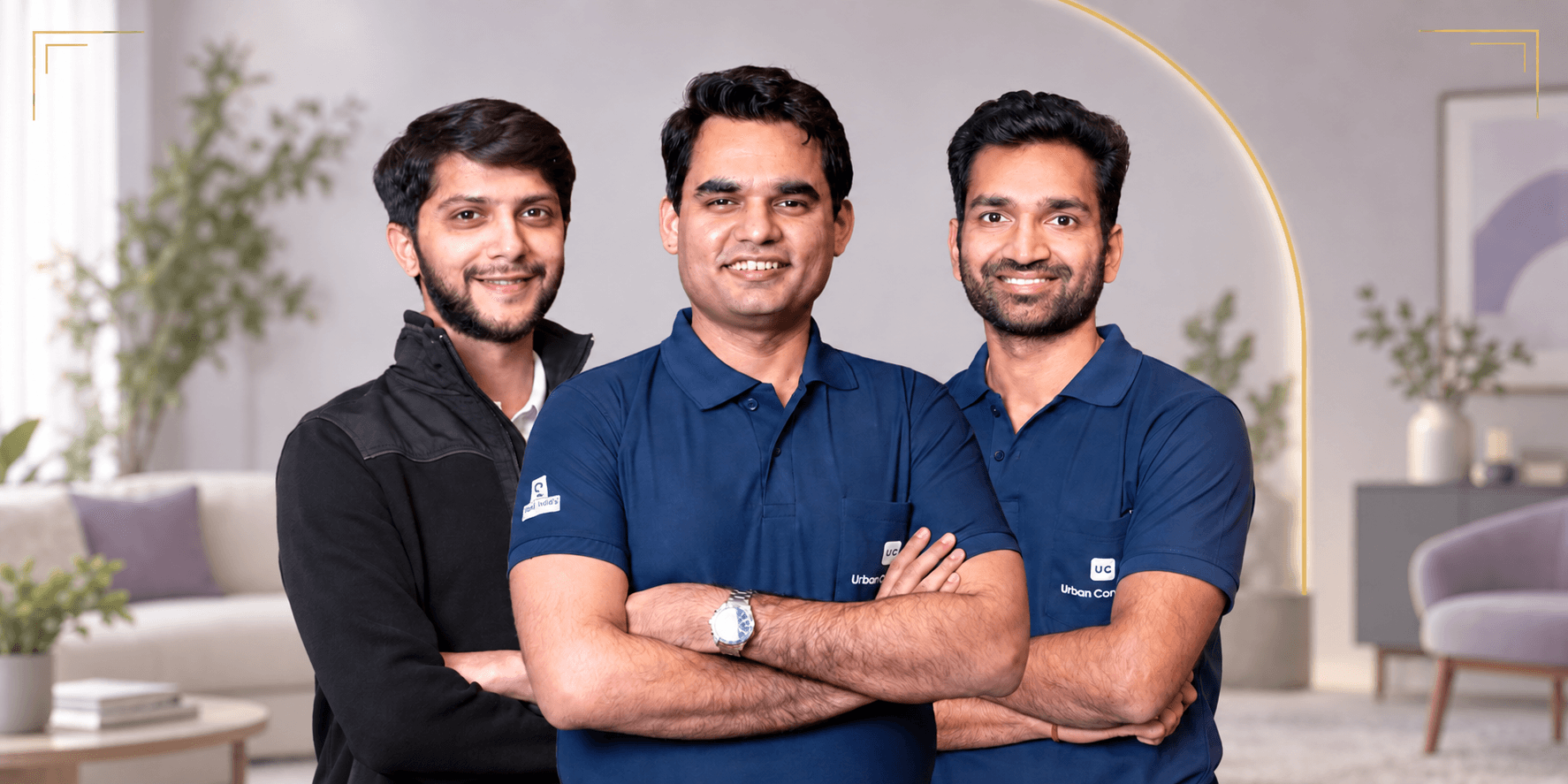
Before.
Abhiraj Bhal and Varun Khaitan were batchmates from IIT Kanpur who had gone on to the Boston Consulting Group. In early 2014 they left to build Cinemabox, which let people stream films on their phones on long journeys. It closed within six months. Around the same time, Raghav Chandra, an engineer at Twitter, was winding down Buggy, an auto-rickshaw hailing app that had not made it far past its pilot.A mutual friend introduced them. What the three had in common, apart from the obvious, was that they had each spent a year learning how a company dies.The next idea came from something ordinary. Finding a reliable plumber, electrician or beautician in an Indian city was a matter of luck and word of mouth, and there was no way to tell in advance whether the person arriving at your door was any good. They started by connecting professionals they could find to people they already knew, then to friends of friends, then to strangers through Facebook groups. The first money they spent on the business was ₹4,000 on Facebook ads.
The bet
We backed them in 2015, before there was a product or a name.
There was very little to analyse. No revenue, no platform, and a category, household services, that had defeated a number of well-funded attempts elsewhere. What there was, instead, was three founders who had each just run a company into the ground and had chosen to do it again rather than go back to consulting or to Twitter.
That is not a small signal. Most people who fail at twenty-eight take the safer option the second time. These three picked a harder problem than the one they had already lost.The hard part
The first version of the business didn't work.
UrbanClap began as a matching service. A customer described what they needed, professionals responded, and the platform took a fee for the introduction. It was asset-light and it scaled easily, which was precisely the problem. The company had no control over what happened after the introduction. Quality varied by professional, prices varied by negotiation, and a customer's experience of the brand was decided entirely by someone the company had never trained.
Fixing that meant rebuilding the business into something much heavier. The company began selecting and training professionals itself, supplying their tools and consumables, setting prices centrally, and standing behind the outcome. By 2025 it was running over 240 training classrooms across seventeen cities.
That decision changed what the company was. It was no longer a place where customers found professionals. It had become responsible for how tens of thousands of people earned a living — their rates, their commissions, their working conditions, the algorithm that decided who got which job.
What it became
Urban Company listed in September 2025, eleven years after the three founders started making phone calls. The offer was subscribed more than a hundred times over, the most heavily subscribed Indian IPO of the year, and the shares opened around 58 per cent above the issue price.
By then the business had become something the category had not had before. Revenue had nearly doubled in two years, from ₹637 crore in FY23 to ₹1,144 crore in FY25, and the company turned EBITDA positive for the first time. It was operating in 51 cities across India, the UAE and Singapore, with a joint venture in Saudi Arabia. Around 48,000 service professionals were working on the platform, most of them trained in the company's own classrooms, and roughly 6.5 million customers used it over the year.
It has also begun building products for the homes it already visits like water purifiers and door locks under the Native brand, and InstaHelp for everyday household work.
The point is still 2014: three people whose previous companies had closed, with no product and no name, choosing a category everyone else had found too hard to organise.
In their words
"Kunal and Rohit were the first investors to believe in Urban Company, even before we launched the platform or decided on the name. Their unwavering support has been a constant throughout our journey, guiding us through ups and downs."
If you're building something before the numbers exist to prove it works, write to us at startups@titancapital.vc.
Explore Stories


"Every brand says it wants to be in every home in India. Very few are willing to rebuild their distribution to actually get there."
Ghazal Alagh & Varun Alagh, Co-Founder, Mamaearth


"Whatever is unsexy, there's more profit. Everybody wants to be glamorous, so that's where the competition is."
Asish Mohapatra, Ruchi Kalra, Bhuvan Gupta & Vasant Sridhar , Co-Founders, OfBusiness


"A payment gateway that takes three weeks to integrate isn't infrastructure. It's a project."
Harshil Mathur & Shashank Kumar, Co-Founders, Razorpay
Every company above started with a single conversation. An idea, a problem, and a founder who was obsessed enough to not let it go. If you're building something real, we want to hear about it